16.06.2026
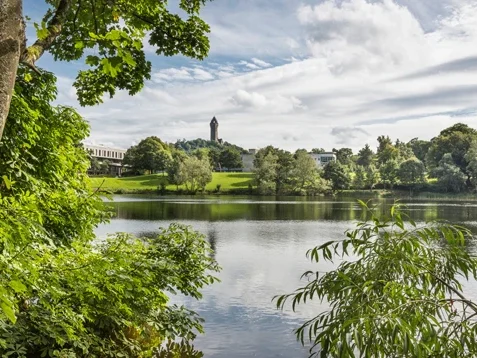 Airthrey Loch on the University of Stirling Campus. Image Credit: University of Stirling.
Airthrey Loch on the University of Stirling Campus. Image Credit: University of Stirling.
Airthrey Loch on the University of Stirling Campus. Image Credit: University of Stirling.As a research fellow in the Data and Methods unit of the Centre, based at the University of Stirling, I spend my days working with large datasets and considering how to use them to better understand communities across the UK. This is largely desk-based work, thinking about what can accurately be said from government data and social surveys, about local areas with differing population characteristics, interspersed with opportunities to talk with others across the centre and beyond.
A major focus of my first year has been to get well acquainted with large social surveys, in order to identify any data which may be useful to our work on community connectedness. Community connectedness can describe how people relate to one another, how supported they feel locally, whether they trust neighbours or institutions, how actively they participate in civic or social life, and how much capacity a community has to respond to needs that arise. Because it is such a broad and multidimensional concept, measuring it in a meaningful and consistent way is challenging.
Is it possible to derive a measure, or indicator, of connectedness at a local level, and map this over time?
The UK has a huge amount of survey information that may help answer these questions. Datasets such as the Census, the UK Household Longitudinal Study (UKHLS, or ‘Understanding Society’), the Scottish Household Survey (SHS), the Community Life Survey (CLS – participants from England) and the National Survey for Wales all contain information linked to civic participation, volunteering, wellbeing, trust and neighbourhood experiences. Many of these surveys have been running for years, or even decades, making them especially valuable for understanding change over time.
Working with large survey datasets also brings significant methodological complexity. Questions can change between survey waves, wording may evolve over time, and response options are not always consistent. Even when surveys appear to ask similar things, differences in routing, sampling or weighting can affect how comparable the results really are. Metadata and variable structures also differ considerably between datasets. A measure of neighbourhood trust in one survey may not directly align with a measure of social support in another, despite covering related ideas. Building comparable indicators therefore requires careful interpretation of both the data itself and the survey documentation behind it.
All questionnaires for each of the surveys were examined for any questions which could be considered to measure aspects of connection or participation. Three dominant themes emerged following this process: volunteering activities, neighbourliness, and civic participation.
Volunteering is commonly used as a measure of community connection because it reflects active engagement with others for collective or public benefit. It signals not only participation in shared activities, but also a willingness to contribute time and effort beyond immediate personal or familial obligations. As such, volunteering can indicate both social integration and commitment to the wellbeing of a wider community. The word ‘volunteer’ can mean different things to different people, and the surveys seek to capture unpaid work by various wordings and prompts, to include as many types of voluntary work and help as possible.
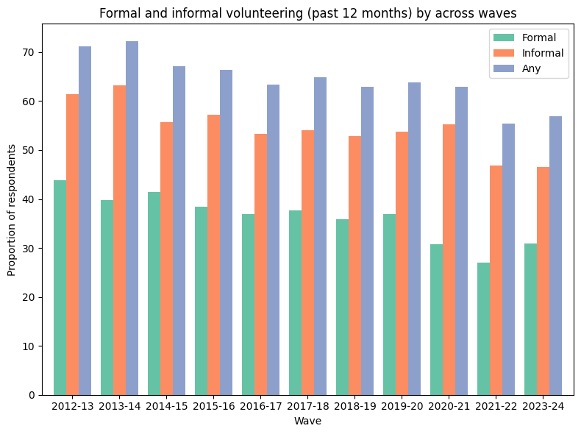
Early analysis has focused on how volunteering is measured across surveys, how participation trends change over time, and whether patterns vary between places or demographic groups. Formal volunteering is understood to refer to unpaid work given to a group or organisation, perhaps involving some recruitment or training. Informal volunteering includes activities such as providing help to neighbours or community, without the activity being directed through an organisation. There are a few ways this is asked about, typically defining informal volunteering as unpaid help given to anyone who is not a relative. Formal and informal volunteering rates over the past decade are shown for England in the image below.
This initial work lays the foundations for developing understandings of individual or local characteristics which encourage or discourage cohesion. It is an exciting piece of work to be involved in.
Image Credit: Airthrey Loch, University of Stirling. https://www.stir.ac.uk/student-life/campus-facilities/the-loch/
Cite this Article:
Couper Kenney, F. (2026). A Day in the Life of a Quantitative Social Researcher: Fiona Couper Kenney. The Centre for Collaboration in Community Connectedness. https://doi.org/10.7190/c4.2026.1647797510