08.06.2026
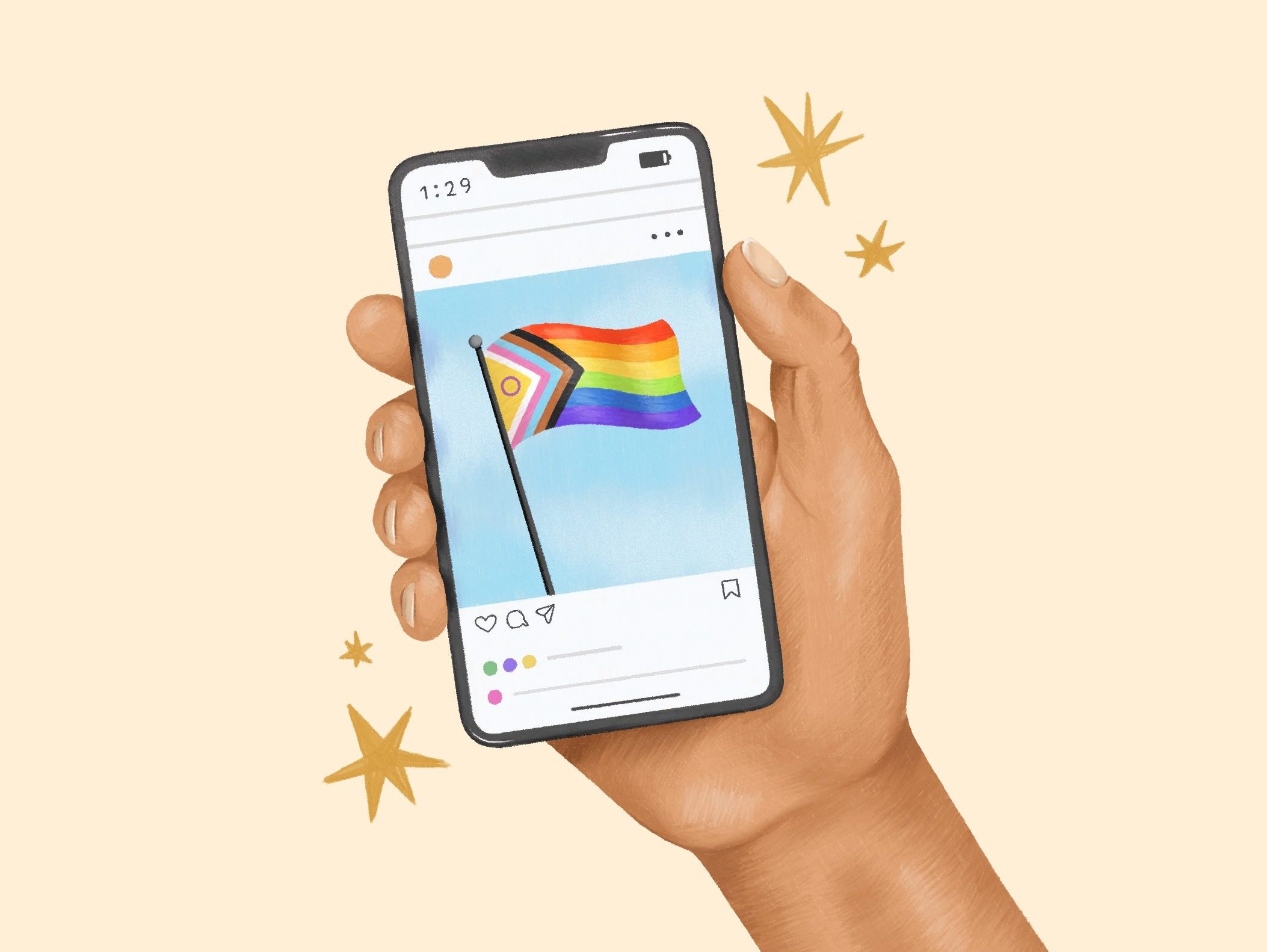 Cover Illustration by Catie Varley.
Cover Illustration by Catie Varley.
Cover Illustration by Catie Varley.June is Pride Month, and it’s important that we recognise how important community can be for LGBTQ+ individuals of all ages, but in particular for young people already facing the challenges of growing up.
With the recent debates about social media hitting the headlines, I’ve been thinking more about how online communities are important, especially to marginalised groups, so June felt like the right time to talk a little bit more about how recent policy news could be impacting community connectedness between young LGBTQ+ people.
In 2025, The Trevor Project reported that LGBTQ+ young people were more likely to agree that they go online as a way of finding people to connect with because they struggle to relate to other people in their daily lives.
What is of particular importance is that transgender young people were more likely to go online than their cisgender peers because they felt they were more able to be their complete selves online, with 79% of those surveyed agreeing.
For a while, there’s been a conversation building around whether or not young people should have so much access to social media, with risks of cyber-bullying, harassment and exposure to harmful content becoming a rising concern for parents, carers and those responsible for safeguarding children and young people.
Following an outright ban on social media for under-16s in Australia, the UK has seen a rise in debate around a similar policy change. London Mayor Sadiq Khan has recently argued for a ban on the platforms for under-16s, stating that until the platforms are proven to be safe, ‘a ban is the only way to stem the harms we know are happening right now’.
But could a social media ban disproportionately affect young LGBTQ+ people?
It’s clear to see how this would be the case. For young LGBTQ+ individuals growing up, loneliness can be a big part of the experience. Social media platforms, forums and group conversations can be key in their sense of belonging and community. It can give them a space to ask questions, to connect with others sharing their experience, or even to just be themselves more authentically.
If we take these spaces away for everyone, then where do these individuals go for support? Does the proposed ban include proposals to invest more heavily into physical spaces and communities for these groups? Will existing services be overwhelmed, or will a generation of LGBTQ+ youth be left to feel isolated and alone?
Privacy campaigners are warning that not only would a ban on social media for under 16’s disproportionately affect young LGBTQ+ individuals, but that a ban would also give tech companies an excuse to ignore calls to make their platforms safer, as they would no longer technically have to worry about under 16s using them.
This in turn has a knock-on effect and could mean in the long-term less is done to protect older LGBTQ+ people from homophobic, transphobic, biphobic and discriminatory harm online.
Under current regulation, under 13s are already prohibited from accessing most social media apps, and yet we know that many bypass these regulations by providing false ages. It’s likely that this would also be the case for an under 16s ban, but a reduction in content limitations could mean that these groups are then exposed to even more harmful content.
Until age restriction methods are tried and tested, weaknesses in the system could easily be exploited.
On the other hand, studies have shown LGBTQ+ young people are much more likely to face bullying and discrimination online, and the perpetrators of such acts often view illegal or dark web content via social media or other platforms.
There is no denying that social media has a dark side, and as with many platforms, when used in the wrong way these apps can pose a serious risk to safety and wellbeing. From this perspective, campaigners may argue that a social media ban could be beneficial.
Of course, there will never be a one-size fits all solution to this problem, but the current proposed legislation perhaps misses a key point and is too focused on ways to restrict tech giants, rather than on the impact that these proposed changes would have on social media users.
We need to think carefully about the intersectionality of those who would be affected and make sure that alternative paths to community building and opportunities to develop social connections are available and accessible for LGBTQ+ individuals.
In the coming months, I am keen to see how the proposals develop, and to see how LGBTQ+ young people, as well as other marginalised communities, are considered within them.
Thank you to Peter Matthews and Ellie Lockley for their help and support in editing and improving this article.
Cawthorne, B. (2021). LGBT+ History Month: Why is the internet important for LGBT+ young people and what can parents and carers do to help them stay safe? UK Safer Internet Centre. https://saferinternet.org.uk/blog/lgbt-history-month-why-is-the-internet-important-for-lgbt-young-people-and-what-can-parents-and-carers-do-to-help-them-stay-safe
Elgueta, A. (2026). London mayor backs social media ban for under-16s. BBC. https://www.bbc.co.uk/news/articles/c0m2evdl1xno
Hern, A. (2022). Young LGBTQ+ people more than twice as likely to experience hate speech online. The Guardian. https://www.theguardian.com/society/2022/oct/17/young-lgbtq-people-more-than-twice-as-likely-to-experience-hate-speech-online
Livingstone, H. (2025). Australia has banned social media for kids under 16. How does it work? BBC. https://www.bbc.co.uk/news/articles/cwyp9d3ddqyo
The Trevor Project. (2025). Online Experiences and Mental Health of LGBTQ+ Young People. https://doi.org/10.70226/DZPX7792
Wareham, J. (2026). Social media ban is “reactionary measure” that will harm LGBTQIA+ youth, campaigners warn. QueerAF. https://www.wearequeeraf.com/social-media-ban-is-reactionary-measure-that-will-harm-lgbtqia-youth-campaigners-warn/
Cite this Article:
Varley, C. (2026) Pride Month, Online Community and Social Media Bans: How Future Policy Could Disproportionately Affect LGBTQ+ Youth. The Centre for Collaboration in Community Connectedness. https://doi.org/10.7190/c4.2026.3540486012