15.10.2026
 Photo by Samer Daboul via Pexels.
Photo by Samer Daboul via Pexels.
Photo by Samer Daboul via Pexels.This article is written by Jessica Ko and Emma Price.
On 14th September 2026, sixteen doctoral and early- and mid-career researchers in The Centre for Collaboration in Community Connectedness (C4) came together for an (un)conference.
The “(un)” in (un)conference was a deliberate choice in wording. The researchers agreed that a typical conference set-up didn’t offer the right kind of space for discussing the complexity of community-based research. Alternatively, the event was co-designed specifically to foster researcher community connectedness within C4, to learn with and from each other’s challenges and experiences, and to think about future possibilities and collaboration. In that respect, it didn’t really look or feel like a conference at all.
Earlier this year, a small group of C4 researchers got together and we began a small-but-mighty planning team for an Autumn conference for C4 researchers. We were keen to connect the dots across our research projects so that collaboration, connection and relationships could flourish.
Early on, we started circling around some questions about the conference:
We had a few hunches about what this could look like. We wanted to challenge some of the assumptions associated with conventional conference formats involving formal presentations, panels, Q&As, and keynote speakers. Instead, we wondered how we might create a space where participants could move beyond presenting research findings to sharing experiences, exploring common challenges, and reflecting on what it means to undertake community-connected research.
We shared a survey to hear what was emerging as important, tricky or exciting in the researchers’ work, as well as understand what they would value from a shared learning space. From this, we had early themes and a format. Researchers across the Centre offered their time and expertise to help bring these to life in a plan for the (un)conference, from design, to logistics, to facilitation. What emerged was a brilliant mosaic of ideas and energy that belonged to us all.
The (un)conference was a half-day, online space for researchers in C4, working across diverse UK-contexts and research projects. The event was peer-led, meaning researchers designed, led, and facilitated the event for each other. Most importantly, the (un)conference was set up as a space for informal conversation over presentation – with one or two activities to guide us along the way.
Participants were invited to choose a theme that most resonated with them and their research:
In breakout rooms, our facilitators guided the researchers through two key activities, digital collaging and storytelling conversations. The activities helped us to follow an action-learning loop: identifying the real challenges, asking questions, actively listening, reflecting and giving feedback, and planning actions.
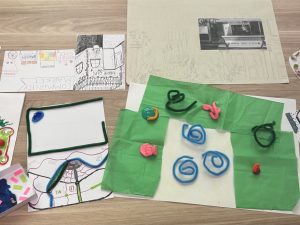
The first activity invited participants to create collaborative digital collages using a shared slide in PowerPoint. The researchers were invited to show, not tell what their theme meant to them. They used images, text, GIFs and other visual prompts to weave together a collective response to their theme.
The collages allowed individual perspectives to come together and form a picture of the opportunities, tensions, and complexities associated with each theme and grounded in real research experiences.
The goal wasn’t to create a piece of art but to ease ourselves into big questions without feeling the need to perform expertise or share research ‘highlight reels’. What emerged was a raw, honest, and often humorous depiction of the realities of doing community-based research for real!*
The second activity involved deeper discussions on the respective topics. These conversations were intentionally exploratory and focused on sharing, reflection, and learning. Researchers shared experiences from their own projects (particularly tensions they encountered in practice), reflected on lessons that had shaped their thinking, and considered what good practice might look like within community-based research. The discussions encouraged the exploration of how to effectively navigate complex relationships, power dynamics, community expectations and the challenging interface between community research and practice.
Here, we weren’t searching for a single truth or consensus. The unexpected avenues of conversation were joyful and were where new perspectives formed. Participants shared that facilitators expectedly balanced expertise and active listening, encouraging the room to bring honesty and empathy to each contribution.
1. Connecting the dots across C4: convergence amongst divergence
One of the most valuable aspects of the (un)conference was the opportunity to discover and connect over common ground. Although participants came from different disciplinary backgrounds, institutions and research areas, many found themselves grappling with similar questions and challenges. Whether discussing co-production, ethics, or power and reflexivity, conversations repeatedly highlighted the importance of relationships, trust, collaboration and ongoing learning. The event created a space where researchers could recognise shared challenges, exchange practical insights and feel part of a wider community of practice.
2. Facilitation for meaningful learning: Holding, not controlling, a shared space
At the end of C4 (un)conference, we encouraged the researchers to collectively reflect on the breakout sessions and overall event using an interactive Mentimeter activity. Comments and feedback on the Mentimeter suggested that the (un)conference successfully struck a balance between structure and openness. While the event was intentionally designed to move away from the format of a traditional conference, many attendees felt that the facilitated sessions provided enough structure to take discussions further than completely open spaces, while still maintaining a conversational, informal atmosphere. Importantly, feedback indicated that participants saw the (un)conference not as a one-off event but as the beginning of an ongoing dialogue, with a strong desire to revisit and build on the themes that emerged through future opportunities for connection, reflection and shared learning.
3. Relationships create momentum: looking forwards
Ultimately, the C4 (un)conference is a move towards creating a different kind of research space: one that prioritises dialogue over presentation, reflection over performance, and connection over formality. It demonstrated the value of bringing researchers together not simply to share findings, but to explore questions, challenges and experiences collectively. We hope this event marks the beginning of an ongoing conversation about how we can continue to strengthen the C4 researcher community, support researcher development, and create spaces where learning happens not only through research outputs, but through supportive relationships with one another.
This blog was written by Jessica Ko and Emma Price, part of the C4 (un)conference team including Faraja Kirubi, Nic Dickson, Aunam Quyoum, Ellie Lockley, Fiona Couper Kenney, and Vita Terry.
*We’ve referred to some of the collages made during the process, but haven’t included them here: they were created for and by the community, and we didn’t seek consent for wider sharing. Next time, we’ll think together about what and how we share our learning.
Image Credit:
Photo by Samer Daboul: https://www.pexels.com/photo/gray-and-blue-click-pen-on-white-notebook-921716/
Cite this Article:
Ko, J. Price, E. (2026). Creating Space for Connection, Reflection, and Mutual Learning: Reflecting on The Centre for Collaboration in Community Connectedness Researcher’s (Un)Conference 2026. The Centre for Collaboration in Community Connectedness.