13.02.2026
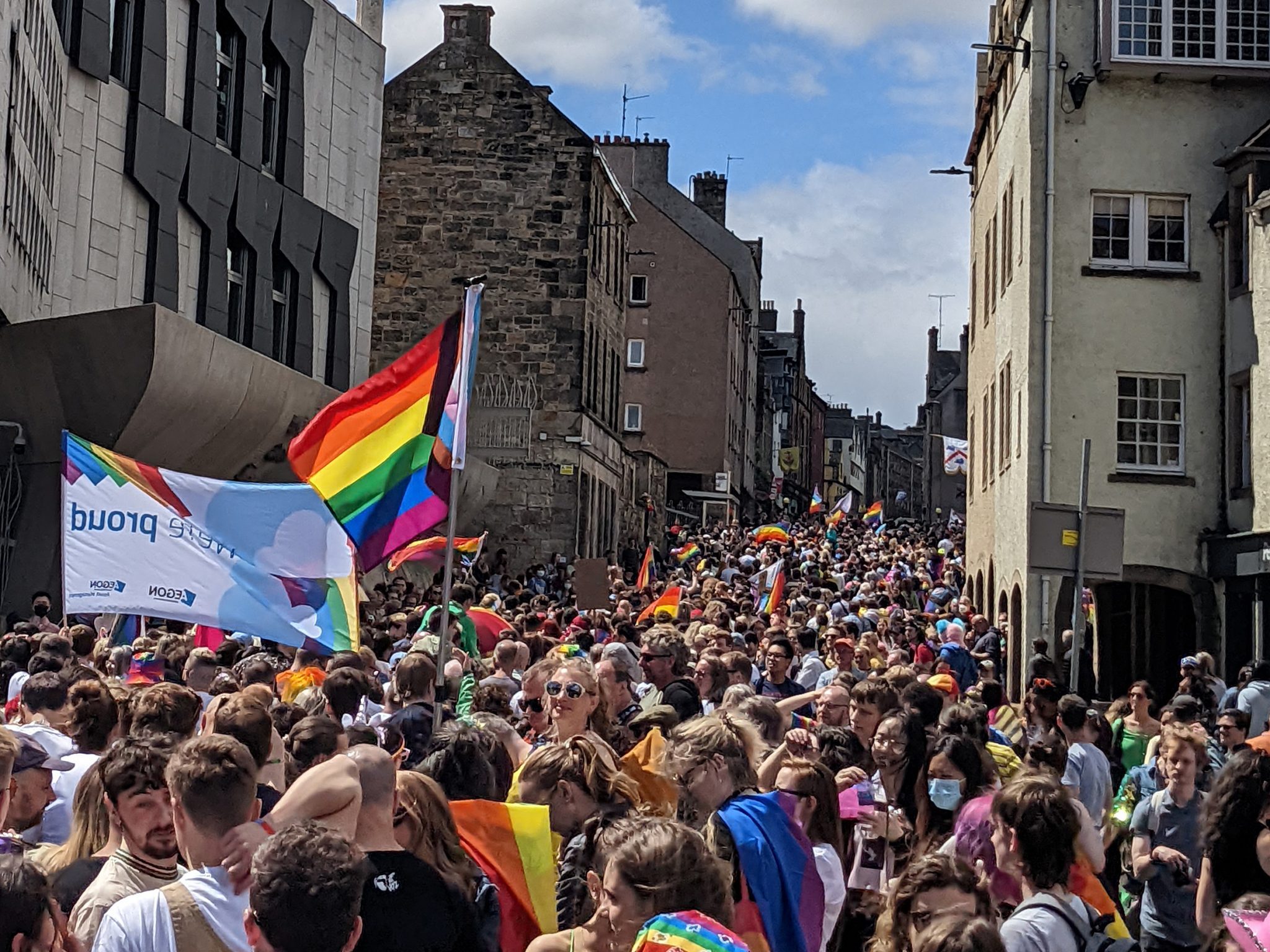 Edinburgh Pride March, 2022, at the bottom of the Royal Mile. Image Credit: Peter Matthews.
Edinburgh Pride March, 2022, at the bottom of the Royal Mile. Image Credit: Peter Matthews.
Edinburgh Pride March, 2022, at the bottom of the Royal Mile. Image Credit: Peter Matthews.

Co-authored by Professor Peter Matthews (University of Stirling) and Charlotte Llewellyn (Sheffield Hallam University).
As queer people we hear the phrase “LGBTQ+ community” all the time. But what does this mean? To us? And to other people? And why do LGBTQ+ communities exist?
We must recognise that across societies, LGBTQ+ communities emerge from oppression and social exclusion. Even in the UK, it was only in 2013 that the final statute criminalising sex between men – in this case criminal law against buggery in Scotland – was finally removed from the statute book.
In a society where your very existence is criminalised, or when the risk of violence, exclusion and stigma, makes you vulnerable, you will find your own community, people like you who you can be yourself with. This could be the caring communities of queer people of colour in the New York Ballroom scene of Paris is Burning (now made mainstream by Ru Paul’s Drag Race); or the anonymous hook-up culture of “cottages” (men’s public lavatories) described evocatively in the many diaries that are now emerging from archives.
Spatial LGBTQ+ communities were also created for more positive reasons – to create a critical mass of a market for queer bookshops, cafes and bars, and very practically to meet romantic partners. Many of these places were inner-city areas with cheap housing, that had been vacated by heterosexual households who moved to better housing in the suburbs. With more limited access to mortgage finance, this was often the only housing these queer households could afford. In the UK, Hebden Bridge (“Happy Valley”) is an example of this – women could not get mortgages without a male guarantor, so lesbians and other queer women from nearby big cities like Manchester, realised they could buy the dilapidated terraced housing with cash and then refurbish it themselves. Such inequalities in access to housing for lesbians, gays and bisexual, persist in Great Britain to this day.
LGBTQ+ communities are also facing the same challenges as every other community in the contemporary world. As noted by Amin Ghaziani in his book There Goes the Gayborhood? the growth of online communities, and particularly dating and hook-up apps like Grindr, Tinder, and Zoe mean that past reasons for colocation have diminished. As with other first-wave gentrifying communities, LGBTQ+ households are also being forced out of the trendy inner-city locations they made fashionable by increasing housing costs. In Great Britain, lesbians, gays and bisexuals still predominantly have worse housing outcomes than their heterosexual counterparts.
Some of the challenges for LGBTQ+ communities are specific to our community though. The counterpoint to the reduction of stigma and removal of legal sanctions for LGBTQ+ has been the growth of acceptance and inclusion. This has resulted in a growing trend of “homonormativity”, where LGBTQ+ people live largely heteronormative lives – the monogamous couple, living in a suburban home, with a pet and/or children, and socialising with other heterosexuals.
The term LGBTQ+ communities is contested within the “community” too. As explored by Eleanor Formby is Exploring LGBT Spaces and Communities, that acronym covers an enormous range of identities, only linked by being non-normative sexual and gender identities. To use stereotypes, a middle-aged lesbian in a hill-walking group does not have that much in common with a young, gay person clubbing in a nearby city. Formby also found that these stereotypes, and the dynamics of LGBTQ+ communities, also mean many LGBTQ+ people feel excluded from communities. Like any community, she found that racism, ableism and ageism, were all experienced within LGBTQ+ communities.
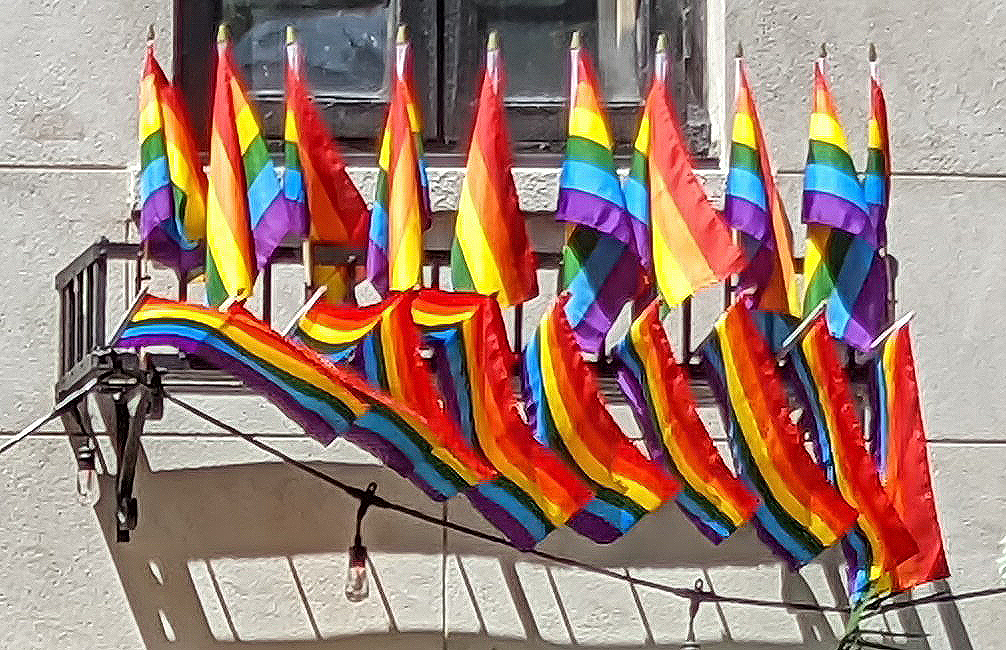
LGBTQ+ communities, and these changing dynamics, will be of interest to the Centre for Collaboration in Community Connectedness. One of our cross-cutting themes is diversity and inclusion, and understanding communities, and the connections within and between communities from an intersectional perspective will be a core research agenda. One of our Community Catapults – Brixton – has famously been one of the UK’s main “gaybourhoods” for decades, although this is increasingly threatened, for the reasons we describe above.*/
And one of the doctoral research projects the centre has funded is on queer communities in the UK’s new towns. This will unpack many of the themes we write about here – the new towns were designed steeped in heteronormative (i.e. the idea that everyone is heterosexual) norms, with the heterosexual nuclear family at its core. Indeed, the architect of the postwar welfare settlement, Sir William Beveridge, described the new town he oversaw, Newton Aycliffe, as a “paradise for housewives”.
While we still know little about how LGBTQ+ people lived, or continued to live in these archetypally suburban spaces, community-led heritage projects, such as MK Q:mmunity Tales, are beginning to shine a light on the topic. With the current government starting the long journey towards delivering a new generation of new towns, now is the opportune moment for us to consider what queer community connectedness looks like in new and existing places.
As the Centre develops, keep an eye out for more on LGBTQ+ communities, and how connections within them, and from them to other communities, can be strengthened.
Peter Matthews is a gay, cisgender man and uses he/him pronouns; Charlotte Llewellyn is a bisexual, cisgender woman and uses she/her pronouns.
Charlotte has also recently published her article ‘Queering the New Towns’ in the Town and Country Planning Association Journal, which is available for members to access here.
Cite this article:
Llewellyn, C. Matthews, P. (2026, February 13). Queer-y-ing Communities: LGBTQ+ Communities Across Time. The Centre for Collaboration in Community Connectedness. https://doi.org/10.7190/c4.2026.6201439930