Background
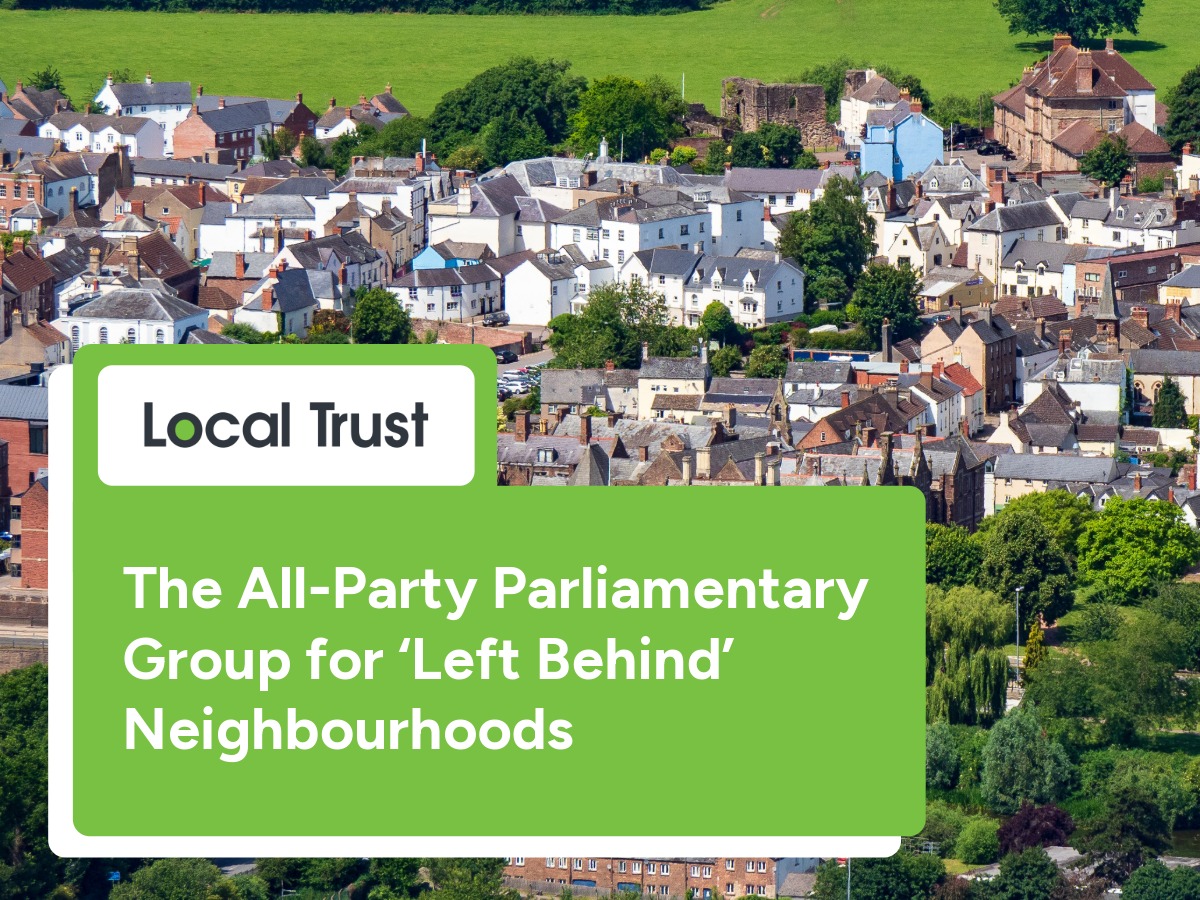
The All-Party Parliamentary Group (APPG) for ‘left behind’ neighbourhoods brought together parliamentarians, residents, researchers and civil society organisations to examine how national policy could better support England’s most disadvantaged neighbourhoods. Active between 2020 and 2024, with Local Trust as its secretariat, it focused on places facing the combined challenges of economic deprivation and weak social infrastructure.
The group was chaired by Paul Howell, then Conservative MP for Sedgefield, and the Rt Hon Dame Diana Johnson DBE, Labour MP for Kingston upon Hull North.
Prior to the 2019 general election, Local Trust published a report, Left Behind? Understanding Communities on the Edge, to mark the launch of the Community Needs Index (CNI). The CNI maps the presence or absence of three key components of social infrastructure – community spaces, level of civic activity, and connectedness (both physical and digital). The report overlaid the CNI with the Index of Multiple Deprivation to identify the neighbourhoods in England that suffered from the worst socio-economic deprivation and least social infrastructure in the country.
Through delivering Big Local, Local Trust had seen how access to places to meet, local organisations and sustained support shaped residents’ ability to act on their priorities. The programme gave residents in 150 neighbourhoods across England control over more than £1 million each. This practical experience helped inform the case for a policy agenda addressing both economic deprivation and weak social infrastructure.
The APPG provided a forum in which residents’ practical experience could be considered alongside research and policy evidence. This helped connect national debates about inequality with the conditions shaping everyday life in neighbourhoods.
Developing the evidence base on ‘left behind’ neighbourhoods
Throughout its lifetime, the APPG held evidence sessions that analysed the challenges and opportunities raised by residents in ‘left behind’ neighbourhoods. The first session formed the basis of Communities at risk: The early impact of COVID-19 on ‘left behind’ neighbourhoods, a report published during the height of the coronavirus pandemic. It outlined how the spread of the virus and subsequent lockdowns were likely to have a greater impact on people in ‘left behind’ neighbourhoods – both clinically and economically – when compared to other similarly disadvantaged neighbourhoods and the country as a whole.
Later that year, the APPG explored how community resilience and strength might be built in ‘left behind’ neighbourhoods. Informed by an evidence session hosted by the APPG, Communities of trust: Why we must invest in the social infrastructure of ‘left behind’ neighbourhoods brought together evidence from residents, community volunteers, academics and policymakers who explained that, over the previous decade, communities had witnessed a deterioration of social infrastructure. Drawing on the CNI, the report highlighted that ‘left behind’ neighbourhoods had seen the greatest loss, and therefore, should be first in line for support to rebuild community hubs, clubs, organisations and networks. It also highlighted the stories of communities who had acted to reverse that trend in their areas – examples like Thurcroft Big Local’s community hub, an impressive example of social infrastructure complete with sports pitches, an indoor sports hall as well as modern changing facilities.
The APPG often worked with external partners with key insight on matters critical to the prospects and experiences of those living and working in ‘left behind’ neighbourhoods. A collaboration with the Campaign for Better Transport led to Connecting communities: Improving transport to get ‘left behind’ neighbourhoods back on track being published in March 2021. The report examined how bus service decline and rail closures had contributed to ‘left behind’ areas being cut off from essential services and amenities. Drawing on the work of communities like Ramsey Million, a group funded by the Big Local programme which took action to save a local bus route, the report identifies how hyper-local targeted investment and support for local government could reconnect these neighbourhoods to decent jobs and opportunities.
In November 2021, Glasgow played host to COP26, at which time the APPG published Levelling up through climate action: A once in a lifetime opportunity to make sure no neighbourhood is ‘left behind’. The report detailed how achieving net zero requires not just commitment at the level of national and local governments: it needs communities to be able to adapt and respond to the particular local impacts of a changing climate. Data and research commissioned for the APPG showed that residents of ‘left behind’ neighbourhoods required targeted support to engage in locally-led climate projects like those pioneered by Ambition Lawrence Weston, a community organisation on the outskirts of Bristol that the APPG drew evidence from on the potential of community energy generation to reduce carbon emissions whilst easing pressure on residents’ finances.
The following year the APPG published Overcoming health inequalities in ‘left behind’ neighbourhoods was prepared by the APPG in partnership with the Northern Health Science Alliance, and explored the growing health disparities between areas identified as ‘left behind’ and the rest of the country. The report paid particular attention to community-led initiatives to improve mental and physical health which, in the APPG’s view, should receive consistent funding and support to make a difference in the communities that need it most. This included a case study from Ewanrigg Local Trust, a voluntary organisation funded by the Big Local programme, who developed the WE WILL youth mental health campaign and HUG A MUG, to provide relationship-based, appropriate support for local people. The success of these programmes underlined the report’s central recommendation: a hyper local, neighbourhood-led approach is needed to improve health outcomes in the most ‘left behind’ areas.
Across these different policy areas, a common finding emerged: neighbourhood conditions mattered. Transport connections, community spaces, local organisations and relationships shaped residents’ access to opportunities and their ability to respond to challenges. Policies addressing health, climate change or economic renewal needed to take these conditions into account.
Assessing the levelling up agenda
Throughout the lifetime of the APPG, one of the then Conservative government’s defining political programmes was the levelling up agenda – a commitment to reduce the inequalities present between the most prosperous and deprived parts of the UK. As part of this thematic focus, the APPG conducted and published research on the role of neighbourhood facilities in supporting residents to meet, organise and take action locally on the issues that matter most to them. Levelling up local outcomes: The importance of community spaces to neighbourhood regeneration set out how the lack of neighbourhood places and spaces undermined levelling up ambitions, while presenting three key recommendations – a long-term strategy for social infrastructure, a reinvented funding model, and a new community right to own – as a way to revitalise levelling up as a programme to help ‘left behind’ areas.
That report signified a turn in the APPG’s work towards a more comprehensive stream of work on the topic of levelling up. From Spring 2022 to Autumn 2023 the APPG conducted a major inquiry into what would level the playing field between England’s neighbourhoods. Following the publication of the government’s Levelling Up White Paper in February 2022, the APPG conducted a series of evidence sessions that brought together expertise from researchers, policymakers as well as the community activists and volunteers working on the frontline to improve their areas through the Big Local programme and other neighbourhood initiatives.
This knowledge and evidence provided the basis for the final report of the APPG’s inquiry, A neighbourhood strategy for national renewal. Assessing the ability of the levelling up agenda to have a material impact on the lives of those based in ‘left behind’ neighbourhoods, the report outlined that this was yet to be achieved but still within reach. One recommendation for making levelling up a reality for these neighbourhoods was establish to a Community Wealth Fund, funded from a new wave of dormant assets, to provide long term, patient investment that could rebuild and restore community confidence and capacity in the most ‘left behind’ areas of England.
The final report of the APPG for ‘left behind’ neighbourhoods was published in January 2024. Sharing prosperity: Community renewal and the UK Shared Prosperity Fund examined whether the UK Shared Prosperity Fund (UKSPF, the UK government’s replacement for the European Structural Funds) was reaching the most deprived and ‘left behind’ neighbourhoods. The APPG found that while the UKSPF allocation formula accounted for deprivation, many ‘left behind’ neighbourhoods in England were not receiving UKSPF funding. Targeted funding to ‘left behind’ neighbourhoods and embedding more meaningful community involvement, members of the APPG concluded, would ensure that UKSPF funds are directed towards residents’ priorities, genuinely improving pride in place and life outcomes in the places that needed it most.
The APPG’s legacy
The work of the APPG came to a close in the lead up to the 2024 General Election. But the bank of evidence and research it built informed and supported a new era of community-led regeneration. The APPG consistently called for policy measures that trusted local people in the most disadvantaged areas to define their own priorities and deliver projects and activities that, speaking to their specific circumstances, can unlock lasting change.
The APPG’s work ended ahead of the 2024 general election, leaving an evidence base and a set of proposals for neighbourhood renewal. Its central argument remains relevant: national ambitions to reduce inequality need sustained investment at neighbourhood level, alongside support for residents to shape decisions and act together. Subsequent commitments, including Pride in Place and the Community Wealth Fund, reflect elements of this approach. Their contribution will depend on how funding, governance and support enable residents to exercise meaningful influence in practice.
Cite this Article:
Local Trust. (2026). Local Trust: The All-Party Parliamentary Group for ‘Left Behind’ Neighbourhoods. The Centre for Collaboration in Community Connectedness. https://doi.org/10.7190/c4.2026.5560900951