28.04.2026
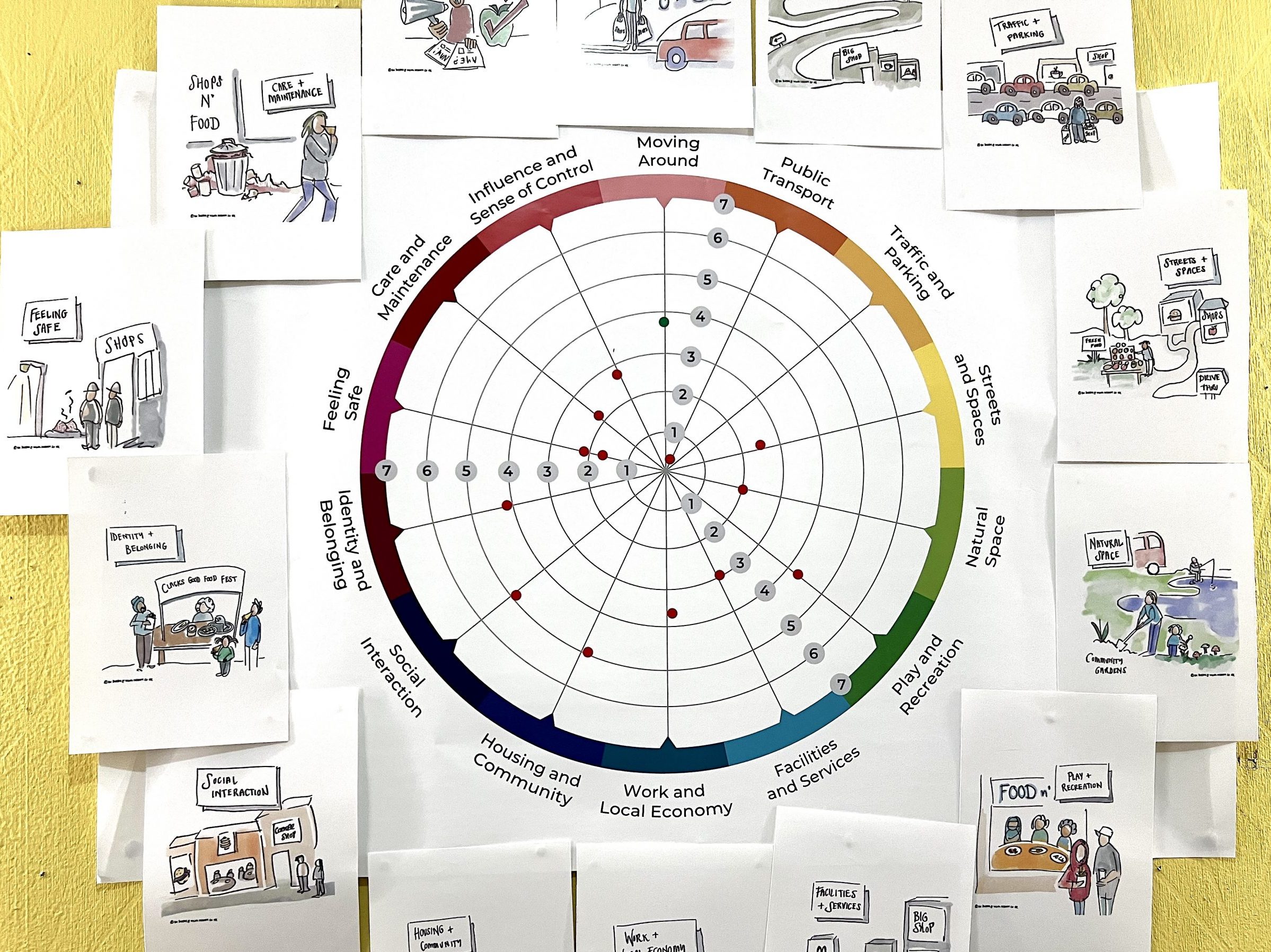 The Place Standard Tool displayed on the wall with the visual prompts arranged around it. Illustrations by Nic Dickson.
The Place Standard Tool displayed on the wall with the visual prompts arranged around it. Illustrations by Nic Dickson.
The Place Standard Tool displayed on the wall with the visual prompts arranged around it. Illustrations by Nic Dickson.
Adapting methods is a routine part of my work as a community‑embedded researcher. It is not about changing tools for the sake of it, but about ensuring that what is brought into a space can actually be used there. Methods do not arrive neutral. They carry assumptions about time, language, confidence, and power. A recent day in Alloa, Clackmannanshire, brought this into focus. I was working with community partners and Public Health Scotland to pilot the Place Standard Tool for Food at the Hive, a community‑based youth space.
The Place Standard Tool itself is well established, but the Place Standard Tool for Food is new and is being piloted in Clackmannanshire. Its development sits alongside a wider policy shift, including Public Health Scotland’s Population Health Framework for 2025–2035, which places strong emphasis on healthy weight and the social and environmental conditions that shape it. In its original form, the Place Standard Tool is a self‑administered survey structured around fourteen questions, each supported by multiple prompts. Participants are asked to rate their place on a seven‑point scale, with space provided to record reasons for their ratings and reflect on priorities. For this pilot, attention was on how the tool functioned once it left a policy context and entered a lived one, and how it might land with groups who are rarely centred in formal consultation processes.
Ahead of the session, I translated the themes we wanted to discuss into a series of drawings. Using a simple cartoon style, I produced visual prompts for each of the fourteen themes, printed them, and hung them on the wall beside a large‑scale A1 version of the circular Place Standard Tool. The room was arranged so that attention could gather around the wall rather than around tables or paper forms.
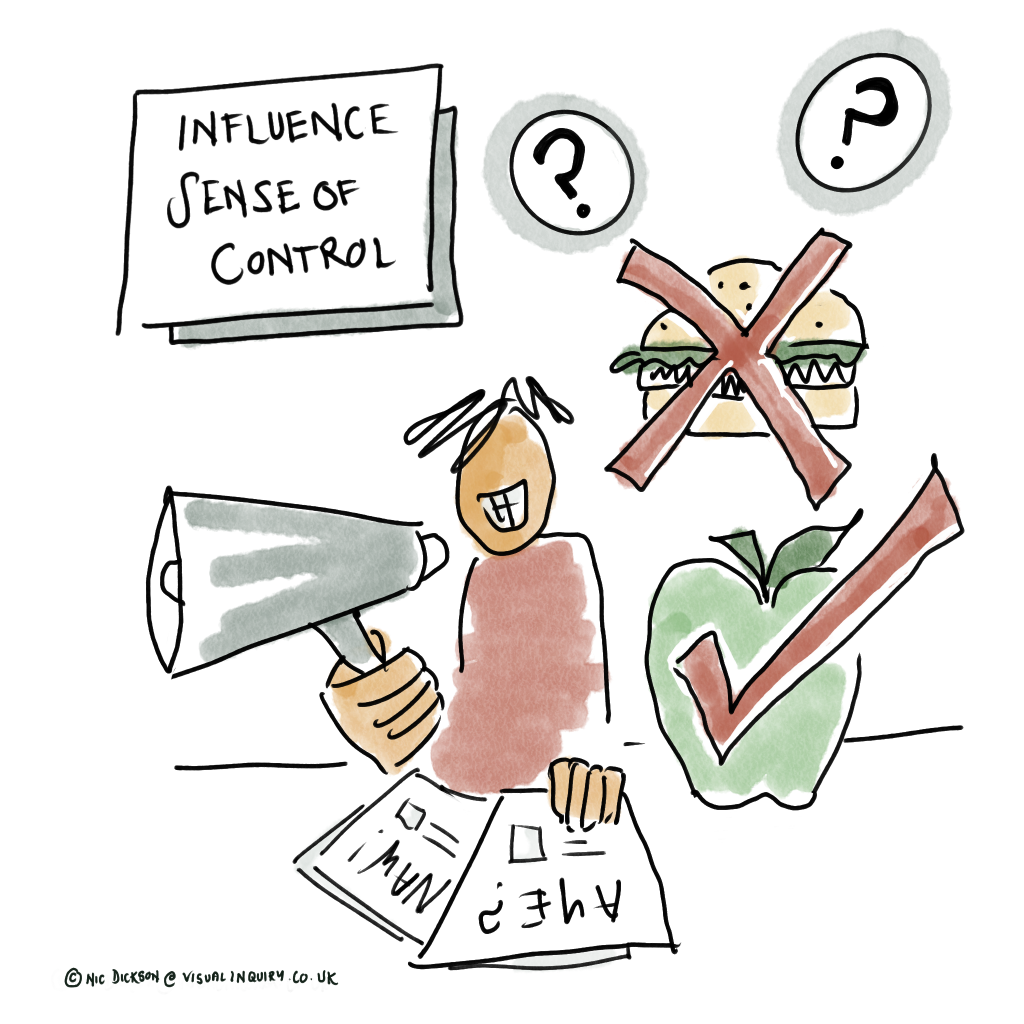
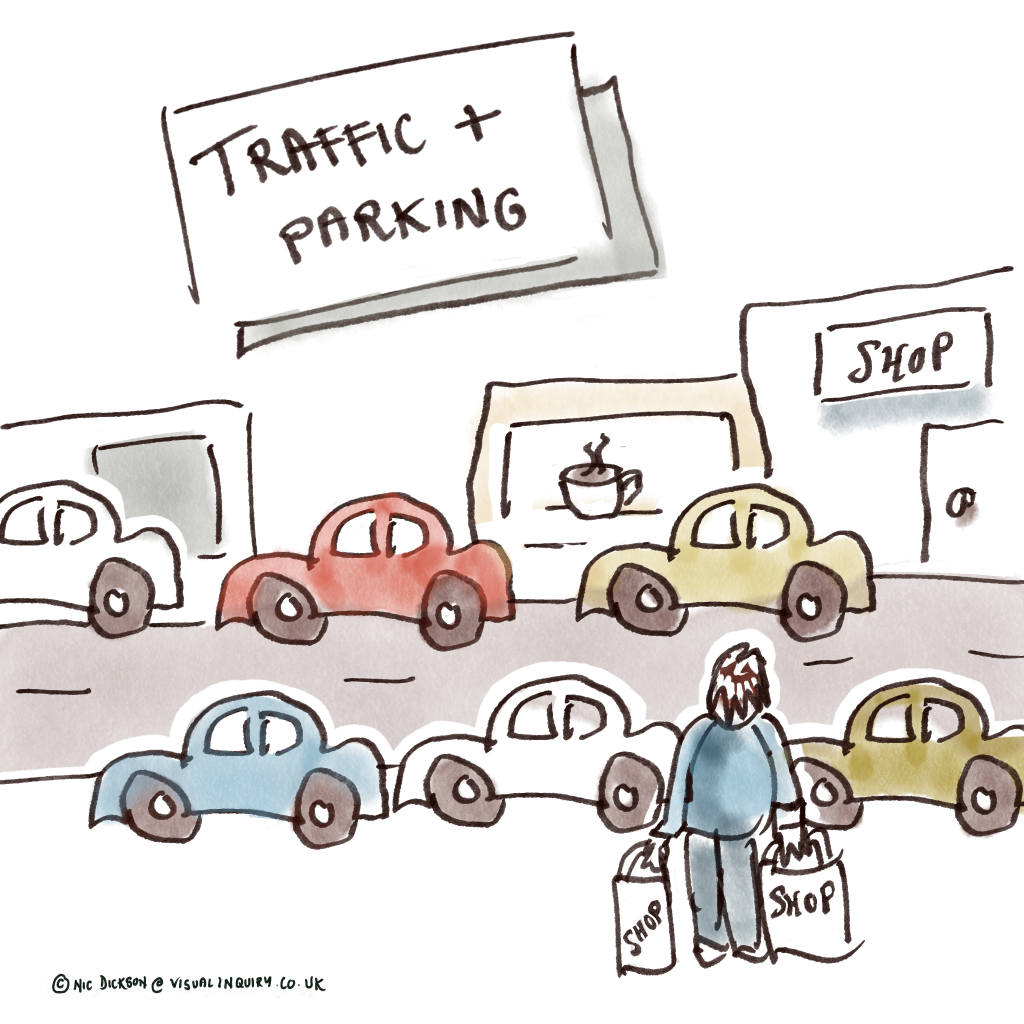
Hand drawn images representing the Place Standard Tool for Food and it’s themes. Illustration by Nic Dickson.
The Hive provides support, routine, and connection for young people, including those who are not attending mainstream educational settings. The young people who attended the pilot session were supported outside school by a Virtual Head Teacher, whose role spans education, care and advocacy. Before the group arrived, teaching staff warned of uneven engagement in previous sessions. When the young people came into the room, questionnaires had already been laid out on the tables. They were not picked up. The group stayed together and spent the first few minutes on their phones.
I noticed that the questionnaires remained on the tables. I did not draw attention to them. Instead, I invited the group to come over to the wall and look at my drawings, explaining that they reflected some of the things we would be talking about that day. Phones were put down and they joined me. I had asked the teacher the names of the participants before they came in, and used them as we talked. I asked each to chose a drawing. The room became more animated. Each young person chose an image and described why they had picked it, what it said about the area, and how it reflected their perceptions of food. There was laughter and different levels of agreement. I asked them to hold these images in mind, as we would return to these themes during a walking interview along the local high street.
The session then moved outside. In small groups we walked through the local area, accompanied by staff and scribes. Walking altered the pace of interaction and changed how conversation unfolded. One young man who had been largely disengaged indoors began commenting on specific images and the places they represented. As we walked, he responded to others and reflected on food, safety and how he felt moving through the area. When the group returned indoors, his attention shifted back to his phone. That brief moment of engagement still mattered. It showed the conditions under which participation became possible, and his words were captured in the notes.
Across the wider group, discussion focused on access, avoidance and safety. There was humour, irritation and contradiction. Jokes about being seen on buses, and anxiety about being judged for using free transport, opened discussion about stigma, visibility and belonging in public space. Some young people spoke at length, while others dipped in and out. I invited the young people to rate how the area fared in relation to food and place using a seven‑point scale. We worked together with the large circular version of the scale mounted on the wall. As different aspects were discussed, I placed sticky dots onto the scale as points were agreed. Safety and transport were rated particularly low, grounded in what had just been observed during the walk and discussed around the images. Some themes generated more energy than others. ‘Facilities and services’ proved harder to engage with, but a score was still agreed. Meaning was built through talk, observation and shared perceptions.
After the young people left, we audio‑recorded reflections from staff who had been in the room, including colleagues from CTSI, NHS, Public Health Scotland, a youth worker, and myself. I used a short discussion guide to structure reflection around what had worked, what had not and what had emerged unexpectedly. We shared notes made by staff during the walk, alongside notes recorded by two colleagues acting as scribes during the session. We recognised that no young person had independently completed the surveys on the tables nor written on the sticky notes we provided. So our reflections focused on what had been observed and felt in the room. Looking at the placement of the dots on the wall, we spoke about how the group appeared to rate their area across the themes, what the consistently low scores suggested about place and belonging, and how the tool functioned when used in this way. Much of the discussion returned to the affective atmosphere of the session, including the strength and range of emotions that surfaced around food, safety, and the area itself.
One unexpected finding concerned digital platforms. Social media and apps shaped where young people spent time, what they ate, and how they accessed food. References to TikTok were common, particularly in relation to social judgement and what felt acceptable. These influences are not addressed in the tool in its standard form. For Public Health Scotland colleagues, this pointed to a gap in how digital environments may impact on peoples perceptions of food and place.
Walking back through Alloa later, I found myself thinking less about the content of the discussion and more about the conditions that had allowed it to happen. These were young people often characterised as disengaged, yet they remained present, contributed, disagreed, laughed and reflected in ways that felt meaningful and sustained. What mattered was that an account of place emerged at all. The tool began to work once it was treated not as something to complete, but as something to work with. In the reflections that followed, we recognised the session as evidence that careful adaptation, rather than procedural adherence, allows methods to support meaningful engagement.
Cite this article:
Dickson, N. (April 2026). A Day in the Life of a Community Embedded Researcher: Nic Dickson. The Centre for Collaboration in Community Connectedness. https://doi.org/10.7190/c4.2026.4442423850