05.06.2026
 Image Credit: Erik Mclean via Pexels
Image Credit: Erik Mclean via Pexels
Image Credit: Erik Mclean via PexelsAt the end of last month (28th May) ‘Social Infrastructures in Neighbourhoods and Cities’ – an edited collection I’ve put together with Professor Alan Latham – was published by Bristol University Press. It brings together a wide range of scholars and practitioners all concerned with how social connection happens in our neighbourhoods, towns and cities.
Across its 25 chapters the book makes the case that the spaces and places that support social connection matter. The book includes chapters on libraries, parks, cafes, allotments, public squares, youth hubs, sports fields, streets, and schools amongst many more. These are the spaces where friends our made, trust is built, and where people find joy and meaning in the places they live.
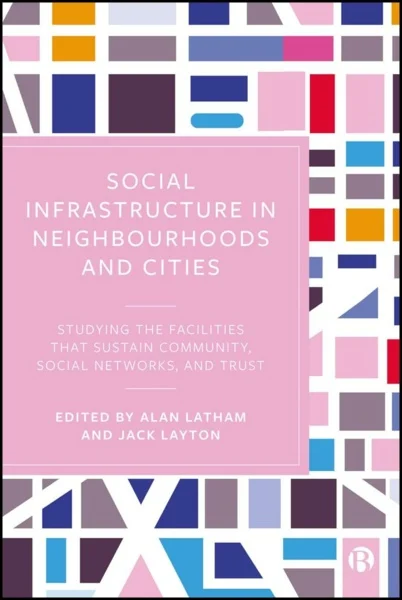
The book represents the culmination of nearly eight years of work thinking, writing, and engaging with the concept of social infrastructure. Now, working with The Centre for Collaboration in Community Connectedness, I am thrilled that the idea of social infrastructure remains relevant, and that it is being developed and applied in new and invigorating ways. Getting this book published represents a milestone for me, and it’s been interesting thinking back to the origins of my work with the concept.
In 2018 – early into the third year of my PhD – I was still reaching around for a concept that would help knit together the threads from what I had found in my fieldwork. My research was examining practices of amateur sport and fitness in public space. I was grappling with why activities like football, swimming and running mattered to people. I was thinking about how the built environment shapes that activity. And about why the go-to concept I was engaged with in Geography – ‘public space’ – didn’t really work for what I had found.
Little did I know that Professor Eric Klinenberg, was working on some of these same issues. His 2018 book Palaces for the People, brought the concept of social infrastructure to a popular audience and made the case for why the spaces and places that facilitate social connection are so important.
Alan, my then PhD supervisor, waved the book at me and suggested it may be helpful – luckily Eric was in London to launch Palaces for the People, and so I went to see him talk at the LSE on 10th October 2018. That same month Alan and I put out a call for papers, for a session titled ‘Social infrastructures and the public life of cities’ that we went on to host at the AAG annual conference in Washington DC in April 2019. We could see potential in the concept of social infrastructure for helping us navigate some of the research questions we were interested in: why do public spaces matter? How do you facilitate more public life? How do you make cities more engaging and joyful places to live?
At the time we could not have foreseen that the coming years would be shaped by when, where, and how people would be allowed to socially connect. The Covid-19 pandemic necessarily and forcibly restricted people’s access to social infrastructure. Up and down the country people felt the acute absence of not being able to have places to go, activities to do, and people to spend time with. It was not long after the pandemic that Alan and I decided that it would be worth developing a book proposal to consolidate the emerging field of research concerned with social infrastructure and the built environment.
And it felt right that ‘Social Infrastructure in Neighbourhoods and Cities’ should be an edited collection. It enabled us to assemble a range of case studies, voices, and experts showcasing some of the latest thinking and research. No single author would be able to write as deeply and authentically about all of the topics covered in the volume.
Editing, I quickly learnt, is a very distinct skill. It involved a lot more emails than I’d anticipated, and pushed me to get better at commissioning, cajoling, reading, and identifying the heart of an issue.
It was a rewarding process, and the book is all the better for the generosity, rigour, and patience of its contributors.
We are also thrilled that Eric Klinenberg, and collaborator Matthew Wolfe, agreed to write the afterword for the book. From a concept I was reaching around for in the third year of my PhD, to a collection of 25 chapters and an emerging field in its own right – it’s been exciting to watch the field of social infrastructure evolve, grow, and become embedded in how communities, researchers, and policymakers think about the places that they live.
The book is available here: https://bristoluniversitypress.co.uk/social-infrastructure-in-neighbourhoods-and-cities
Image Credit: Photo by Erik Mclean via Pexels: https://www.pexels.com/photo/books-on-brown-wooden-shelves-8045884/
Cite this Article:
Layton, J. (2026). Social Infrastructure in Neighbourhoods and Cities: An Edited Collection. The Centre for Collaboration in Community Connectedness. https://doi.org/10.7190/c4.2026.3453379887