Ellie Lockley is a senior researcher in the Sheffield Creative Industries Institute who works in the Centre as Ethics and Digital Technologies lead. In this latest blog, she reflects upon her new role as chair for Rotherham Pride in Place.
When I saw the opportunity to join the Pride in Place Board in Rotherham I jumped at the chance. I never thought it would lead to being the Chair! What an amazing opportunity! And it’s one I’m so grateful for.
I’ve worked at Sheffield Hallam University for a long time and I’ve worked with many different academics (from Computer Scientists to Human Computer Interaction scientists, Sociologists, Economists, Lawyers, Artists) and clients from different sectors (Health, Business, VCSE, Arts and Cultural, LAs to name a few) but I wanted the opportunity to experience a new system whilst working on something that really matters me – giving back to my community.
As an academic with quite few years of experience in research, I grappled with to what extent I should be observing my experience. Whilst I’ve decided to keep research and the role separate for now, there’s so much of my day-to-day understanding of research, project management, public engagement, and evaluation that feeds through to this work. However, I must say there is a lot of navigating of different ways of working to do!
Taking on a public facing role like this comes with a weight of responsibility – suddenly I’m in a leadership position which must facilitate the management of twenty million pounds over ten years! With that, comes a new kind of power. However – I’ve decided to save those thoughts for another day! (Watch this space?).
What is Pride in Place?
So, what is Pride in Place I hear you say?! It’s a UK government programme designed for community empowerment. The Ministry of Housing Communities and Local Government (MHCLG) are investing up to £5.8 billion across 284 communities over a ten-year period. Rotherham has been successful in securing £20 million which be will spent across six central wards.
The programme aims to strengthen civic pride, improve local places and services, and empower communities to influence the future of their neighbourhoods, so suddenly that opportunity to work in a different system has faded, and the enormity of what we’ve collectively taken on comes to the forefront!
The programme is delivered through a Neighbourhood Boards model, which means we are an independent board made up of residents, who are locally focused and directly responsible for developing and overseeing delivery of the funding.
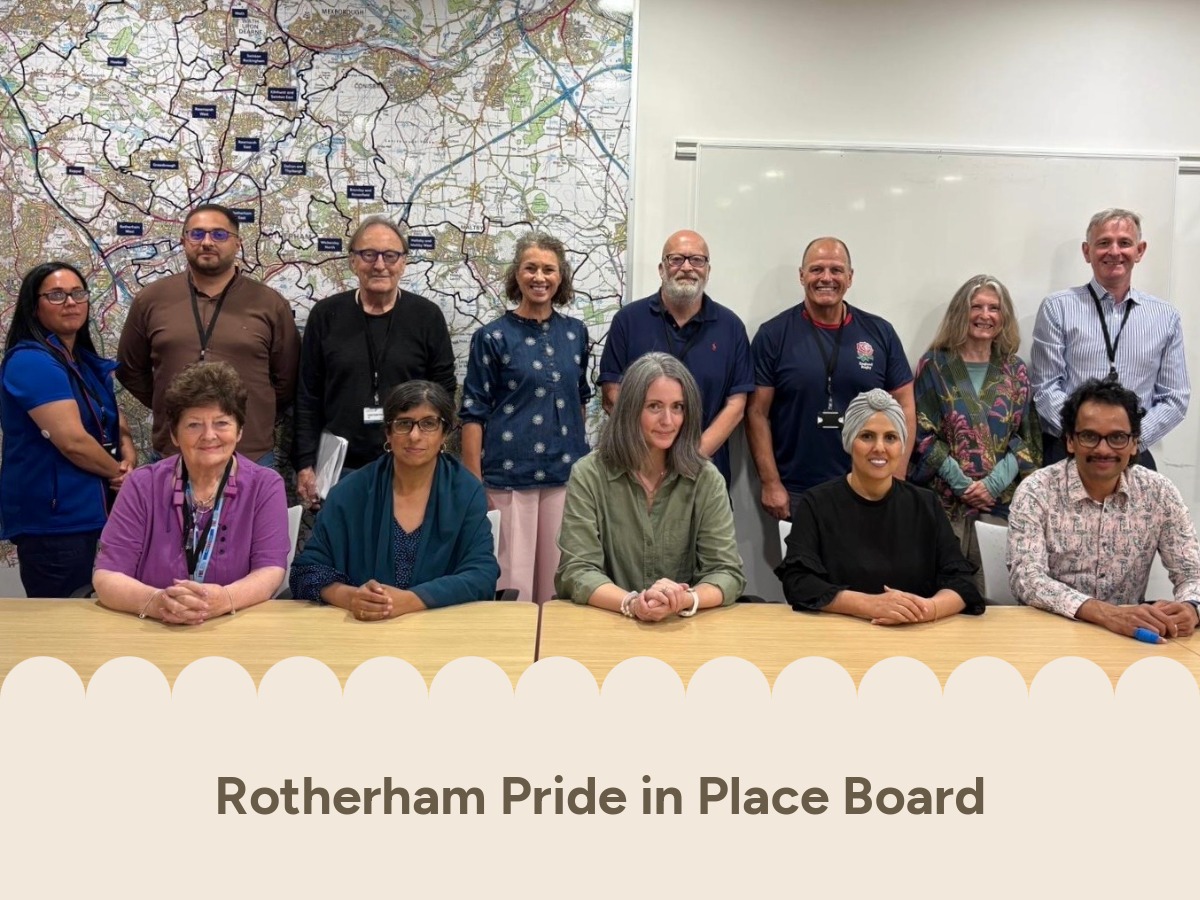
Our board is made up of myself as chair, and then fourteen other board members which includes two councillors and one MP. We are working closely with Rotherham Metropolitan Borough Council who is our accountable body.
What is Pride in Place money for?
The programme is generally intended to support improvements such as:
- High streets and town centres.
- Parks, green spaces and public realm improvements.
- Community facilities and amenities.
- Cultural, leisure and community activities.
- Youth provision and community support initiatives.
- Projects that strengthen local pride, belonging and participation
Community engagement
Part of our remit is to ensure that we include local people in the decision making and that local investment reflects community priorities. The Rotherham Pride in Place Board has agreed to expand our programme of community engagement, and this will be continuous. We have attended local events, showcased the initiative and spoken directly with residents about their experiences of living in Rotherham.
In truth this work has developed organically. As a board, I don’t mind admitting that we are drawing upon our existing skillsets (luckily, we are rich in skills on this board) and learning as we go, testing different approaches, reflecting on what works and adapting our methods accordingly.
It’s safe to say that there’s a large amount of autonomy within the programme, and whilst that creates space for innovation, for me personally it also means I have had to revise some of my own assumptions about how people’s opinions are gathered!
For our board, the purpose of engagement is to help us deepen our understanding of local priorities and ensure that our work remains grounded in residents lived experiences. Conversations on the ground and in communities continue to reveal valuable insights, but they also highlight significant variation between neighbourhoods and demographic groups.
With my research hat on, I know we need to find the voices from as many people as possible – including those who might not usually speak up, and our board agrees – we must continue to engage all of our residents, including those who might be considered to be hard to reach.
This, at times, can be quite challenging. We have a broad demographic across our six wards which form the central Rotherham area. Many people have lost faith in local authorities and services, so winning their hearts and minds will remain embedded within our approaches. We are trying to use word of mouth in addition to our vast networks because we know that this is the best way to convince people that this programme is for them, their neighbourhoods and their communities!
What has our engagement told us so far?
Following feedback and broad public consultation, several recurring themes have emerged.
The condition of public spaces is frequently mentioned with parks and green spaces being a priority for people who use them. Residents also talk about traffic issues, and road safety. Other conversations focus on educational opportunities, activities for children and young people, community facilities, and accessibility.
Antisocial behaviour and petty crime are also common concerns which fall outside the board’s direct remit, making it difficult for us to influence them directly. This shows that we need to establish mechanisms for sharing community feedback with organisations that do have responsibility in these areas, including the Local Authority and South Yorkshire Police.
Alongside these specific concerns, people regularly express a desire for stronger community infrastructure (places where they can go and be with other people) and more opportunities to connect with others locally. There is a clear sense that many of the spaces, services and activities that once helped bring communities together have been reduced over time. Residents we’ve spoken to have suggested, local hubs, events and initiatives that foster social connection and a sense of belonging.
Community conversations have also highlighted the importance of challenging some of the narratives that surround Rotherham. While concerns about the town centre are often raised, declining high streets and local services are issues that are not unique to Rotherham. They are part of wider national trends. So, one challenge we face is managing expectations while remaining responsive.
A related theme concerns community ownership and agency. For some people we’ve talked to, there seems to be an expectation that the council should resolve every local issue – for example cleaning up rubbish and removing weeds. While public services clearly have important responsibilities, there are also opportunities for residents to take action themselves where they are able to do so.
Across Rotherham there are many examples of individuals and groups who actively improve their neighbourhoods and take positive civic action – a great example of this can be seen through the litter picking networks.
We want to promote this work, and the existing voluntary work that’s happening across Rotherham and encourage people to engage with it. Encouraging this sense of shared ownership feels important if we are to build stronger and more resilient communities.
We also hear many positive stories from residents who have lived in their neighbourhoods for decades and speak warmly about where they live and their communities. These perspectives are often less visible than negative commentary, particularly online. So, it’s important that the board helps amplify these positive narratives alongside acknowledging genuine challenges.
Lessons Learnt…
It feels obvious to say that this work is fundamentally relational. Our approach to community engagement is not simply about collecting feedback or delivering projects, but rather involves building trust, managing expectations, addressing misconceptions, and facilitating constructive conversations. Ultimately, we want to help people feel connected to one another and to their communities, and that takes time as well as considerable effort!
Similar challenges exist in the digital space. Whilst social media can be a useful communication tool, it can also amplify and reinforce negativity. We know we need to take a hybrid approach (online and face-to-face) to reach people. This also has implications for communications. Our messages need to be clear, straightforward and accessible (again I feel like I’m stating the obvious here!).
The challenge lies in providing enough information to be transparent and informative without overwhelming people with unnecessary detail. (A bit like writing this blog really!) Achieving that balance is not always easy, but it is essential if we want residents to engage meaningfully with the work.
Whilst there does feel like an underlying pressure to get the funding out into the public, we want to ensure that the mechanism and process for doing that is robust and fair. Ultimately, we want to deliver this programme well and do our best for the people of Rotherham.
So, whilst it seems as though nothing is happening on the surface much of the work we have been doing has involved listening, learning, adapting and building relationships. These quieter aspects of the process are often the least visible, yet they are arguably the most important in creating the conditions for lasting change.
Watch this space for more reflections as we evolve as a board and as I figure this leadership thing out as Chair. If you happen to be on Facebook and want to follow our journey our page is ‘Proud of Rotherham’ If you have any questions, please feel free to email on e.lockley@shu.ac.uk
Cite this Article:
Lockley, E. (2026). Reflections on the Development if Rotherham Pride in Place: Ellie Lockley. The Centre for Collaboration in Community Connectedness. https://doi.org/10.7190/c4.2026.0781103748