Introduction
This article explores how the policy environment for resident-led organisations, neighbourhoods and funders changed between 2010 and 2026, and how Local Trust responded. It does not suggest that Local Trust brought about these changes alone. Rather, it traces how learning from Big Local was converted into evidence, alliances and policy proposals that contributed to a wider shift in thinking.
Across this period, neighbourhood policy moved from austerity, voluntarism and short-term competitive funding towards greater recognition of the value of social infrastructure, community capacity and long-term, allocative investment. This change is incomplete. Recent programmes give neighbourhoods more prominence and direct substantial resources towards them, but important questions remain about resident power, local capability and the infrastructure needed to sustain community-led change.
2010 to 2015: Austerity, the Big Society and the creation of Local Trust
The early 2010s combined deep reductions in public spending with a political emphasis on volunteering, charitable giving and social enterprise. Following the 2008 financial crisis, the Cameron-Clegg coalition government introduced an austerity programme that placed local government under sustained financial pressure. Councils reduced non-statutory spending on children’s centres, youth services, libraries, leisure facilities, transport and community buildings. These changes weakened many of the services, organisations and spaces on which neighbourhood life depended.
At the same time, the Big Society agenda sought to give people and communities a greater role. Its ambitions for local initiative and volunteering sat uneasily alongside the loss of local services and infrastructure. Communities were being asked to do more, just as many of the institutions that enabled collective action were being reduced.
It was in this context that The National Lottery Community Fund (TNLCF) established Local Trust to deliver the Big Local programme. TNLCF also needed to put substantial Lottery resources to work in communities and wanted to respond to lessons from earlier place-based programmes, where short timescales and delivery through intermediaries had sometimes limited the resources and control reaching residents.
Why an independent trust
Local Trust’s independent trust model was intended to lock resources into a clear long-term purpose while protecting the Big Local programme from short-term institutional and political change. It:
- provided a clear and protected purpose for the funds
- enabled a ten-year programme, subsequently extended to fifteen years
- created time to build resident confidence, relationships and capability
- kept community decision-making at the centre of the programme
- offered a practical route for substantial Lottery funding to reach places that had not always benefited proportionately.
From 2011 onwards, Local Trust concentrated on establishing Big Local’s delivery infrastructure, support arrangements, learning offer and communications. The organisation’s primary task was to enable residents in 150 areas to decide how at least £1 million should be used to improve their neighbourhood over the long term.
2015 to 2020: Weakening local infrastructure and a move into policy
By the middle of the decade, the effects of austerity were combining with wider political and social disruption. The 2015 general election was followed by the 2016 referendum on membership of the European Union and a prolonged period of political uncertainty. Across many places, community spaces, pubs and libraries closed; youth provision was reduced; and local authorities faced pressure to deliver more with fewer resources.
The effects were not evenly distributed. Neighbourhoods already experiencing high levels of deprivation were more exposed to the loss of institutions, facilities and local capacity. Where people had fewer places to meet, organise and build relationships, collective action became harder to sustain.
During this period, experience from Big Local increasingly showed that money and resident decision-making alone were not enough. Progress was also shaped by the strength of local relationships, organisations, spaces and support. Areas with stronger foundations were generally able to organise and move through the early stages of the programme more quickly than those where local infrastructure was weaker.
In 2017 Local Trust’s Board made a strategic decision to invest more in Local Trust’s external policy work and a policy function was established in 2018 to share learning from Big Local and use it to inform the policies and practices of government, local authorities, as well as trusts and foundations. This marked an important organisational shift: Local Trust continued to deliver Big Local whilst also translating its experience into a wider argument about what communities need to exercise power. It also required the programme to be positioned as a clear departure from the failings of Big Society.
Local Trust also helped establish the Community Wealth Fund Alliance in 2019 and served as its secretariat over the course of the successful campaign. The alliance made the case for long-term, hyperlocal investment in communities facing both economic disadvantage and weak local capacity, to be funded by the government’s expanded Dormant Assets Scheme. Its proposals combined resident-led decision-making with investment in confidence, relationships, services and facilities.
2020 to 2024: From programme learning to evidence and influence
The Covid-19 pandemic exposed both the importance and the uneven distribution of community capacity. Local groups and neighbourhood organisations often played a vital role in supporting residents, but places entered the crisis with very different levels of social infrastructure. The pandemic therefore reinforced a central lesson from Big Local: communities respond more effectively, and are more resilient to external shocks, when relationships, organisations and places to meet already exist and have been supported over time. This was reinforced during the subsequent cost of living crisis.
The Community Needs Index and doubly disadvantaged neighbourhoods
In 2018, Local Trust worked with the Oxford Consultants for Social Inclusion to develop the Community Needs Index (CNI), creating the first objective measure of social infrastructure that could be explored at a national scale. The index complemented the Index of Multiple Deprivation by measuring the local social and cultural conditions that can affect people’s life chances, including the strength of civic assets, connectedness and participation.
Used alongside the Index of Multiple Deprivation, the CNI identified neighbourhoods experiencing a double disadvantage: high socioeconomic deprivation combined with weak social infrastructure. Evidence showed that residents in these ‘left behind’ or doubly disadvantaged places experienced poorer outcomes than the national average and, importantly, than similarly deprived places with stronger social infrastructure. The analysis reframed the problem. Poor outcomes did not reflect a lack of ability or aspiration among residents; they also reflected long-term underinvestment in the institutions, services, facilities and relationships that enable communities to thrive.
The index subsequently moved beyond making neighbourhood disadvantage visible. Combined with deprivation data, it formed part of the methodology used to identify areas for the Community Wealth Fund and Phase II of the government’s Pride in Place programme. Its use in programme design is a tangible example of Local Trust’s evidence helping to shape where national investment is directed.
The APPG for ‘left behind’ neighbourhoods and Community Wealth Fund campaign
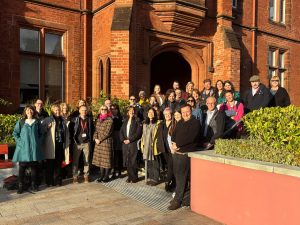
Local Trust used this evidence through two connected routes. It acted as secretariat to the All-Party Parliamentary Group for ‘left behind’ neighbourhoods between 2020 and 2024. The cross-party group enabled residents, volunteers and workers to share their experience with national and local decision-makers and examined practical responses to neighbourhood disadvantage, including through a major inquiry into the government’s levelling up agenda.
In parallel, the Community Wealth Fund Alliance built a broad coalition around a specific policy proposition: long-term, patient and resident-led funding for communities with weak social infrastructure. The APPG created political space and evidence; the alliance mobilised support around a deliverable solution. Together, they helped move the argument from describing neighbourhood disadvantage towards proposing a different model of investment.
Levelling up and the limits of competitive funding
The Conservative government’s levelling up agenda created an opportunity to argue that regional inequality could not be addressed through economic investment alone. Government rhetoric increasingly referenced pride in place, local leadership, community strength and quality of life, providing space for discussion of disparities between places at a hyper-local or neighbourhood level. Local Trust used this opening to promote the Community Wealth Fund, investment in ‘left behind’ neighbourhoods and stronger support for community leadership.
However, much levelling up funding continued to be distributed through competitive bidding. Local authorities had to spend scarce time and money preparing bids to multiple central funds, with no guarantee of success. This approach favoured places with the capacity to navigate funding systems and did little to build the foundations needed in neighbourhoods with the weakest infrastructure. Local Trust’s alternative was allocation based on evidence of need, combined with long-term support and resident involvement.
A new neighbourhoods policy
Ahead of the 2024 general election, Local Trust brought these arguments together in its manifesto: A new neighbourhoods policy. It argued that repeated regeneration programmes had often failed to leave a durable legacy because communities lacked meaningful control and because too little attention had been paid to the social infrastructure that sustains participation over time.
The manifesto was the culmination of a connected body of work: learning from Big Local identified the problem; the CNI made it more visible; the APPG brought lived experience into Parliament; and the Community Wealth Fund Alliance developed and campaigned for a practical response.
2024 to 2026: Neighbourhood policy moves into the mainstream
Labour’s 2024 election victory brought a new set of national missions focused on economic growth, clean energy, safer streets, opportunity and the NHS. Although neighbourhoods were not a mission in their own right, successful delivery depended on stronger relationships between public institutions and communities and on the capacity of local people to shape change.
The Independent Commission on Neighbourhoods was launched in 2024, funded by Local Trust and chaired by Baroness Hilary Armstrong, to examine the condition of neighbourhoods across England and the role they could play in national renewal. Its creation reflected the growing prominence of neighbourhoods as a unit of policy and public service reform.
The Community Wealth Fund
In September 2025, government confirmed that the Community Wealth Fund would target doubly disadvantaged communities with the greatest need for investment in community and civic capacity. The decision secured £175 million over four years (£87.5m from the Dormant Assets Scheme, which was subsequently matched by the National Lottery Community Fund), with TNLCF responsible for programme design and delivery.
The final programme was shaped by government and the Lottery rather than by Local Trust alone. Nevertheless, its focus on long-term capacity building in doubly disadvantaged neighbourhoods reflected the core case advanced through the CNI, APPG for ‘left behind’ neighbourhoods and the Community Wealth Fund Alliance.
Plan for Neighbourhoods and Pride in Place
The Conservative government introduced the Long-Term Plan for Towns in 2023, initially identifying 75 towns for ten-year investment. Following the 2024 election, the Labour government retained and revised the programme, first as the Plan for Neighbourhoods and then as Pride in Place. The original towns became Phase I; Phase II added 209 smaller, MSOA-level areas, selected using a different methodology that included the Community Needs Index. Alongside the expansion in scale, the policy emphasis moved beyond town-centre regeneration towards stronger communities, resident influence and neighbourhood renewal.
The Pride in Place programme brings together substantial ten-year investment for selected towns and neighbourhoods, alongside shorter-term impact funding. Its long timeframe, commitment of resources to named places and ambition for residents to shape local priorities have clear parallels with Big Local. It also marks a shift away from relying exclusively on competitive bidding towards allocating funding to identified places. The Pride in Place programme’s delivery arrangements however are materially different. Local authorities act as accountable bodies; MPs and councillors sit on Neighbourhood Boards; substantial proportions of funding are designated for capital spending; and places are expected to move towards a community-led model of delivery within three years. These arrangements may help manage a large public investment, but they also affect how much discretion residents and Boards can exercise. The comparison raises a practical question for Pride in Place: how can the programme provide accountability and support while allowing communities genuine authority over the changes they want to make?
The growing movement for community power
Local Trust’s contribution formed part of a wider movement. Locality, Power to Change and other organisations also made the case for community ownership, stronger local organisations and a greater transfer of power to residents, alongside campaigns such as We’re Right Here. Joint and complementary work helped secure measures such as the Community Wealth Fund and contributed to the broader recognition of social infrastructure, community business and neighbourhood-level action.
Developments such as the Greater Manchester Combined Authority’s Live Well model point towards another strand of this emerging settlement: public service reform organised around neighbourhoods and stronger relationships between statutory bodies, the voluntary and community sector, and residents. These approaches connect community power with prevention, health and devolution, rather than treating it as a separate policy agenda.
2026: What has changed and what remains unresolved
By 2026, several ideas that had been marginal in the early 2010s had moved closer to the centre of policy. Neighbourhoods were increasingly recognised as important places for investment and public service reform. Social infrastructure and social capital had entered government language. Long-term and allocative funding had gained ground over short-term competitive programmes. Community capacity was more often understood as something requiring deliberate investment rather than something that could simply be assumed.
Local Trust contributed to this change by connecting practical experience, data, resident voice, alliances and specific policy proposals. Its influence lay not in any single intervention, but in building a consistent case over time and working with others to turn that case into credible programmes.
The Pride in Place programme shows how far the case for long-term neighbourhood investment has travelled. Its early delivery also shows that allocating money and creating Neighbourhood Boards are only a starting point. The test is whether places have the people, relationships, freedom and sustained support to build community leadership, share power with public institutions and adapt their governance over time.
Cite this Article:
Local Trust. (2026). Local Trust and Changing Neighbourhood Policy, 2010-2026. The Centre for Collaboration in Community Connectedness. https://doi.org/10.7190/c4.2026.0277581722